




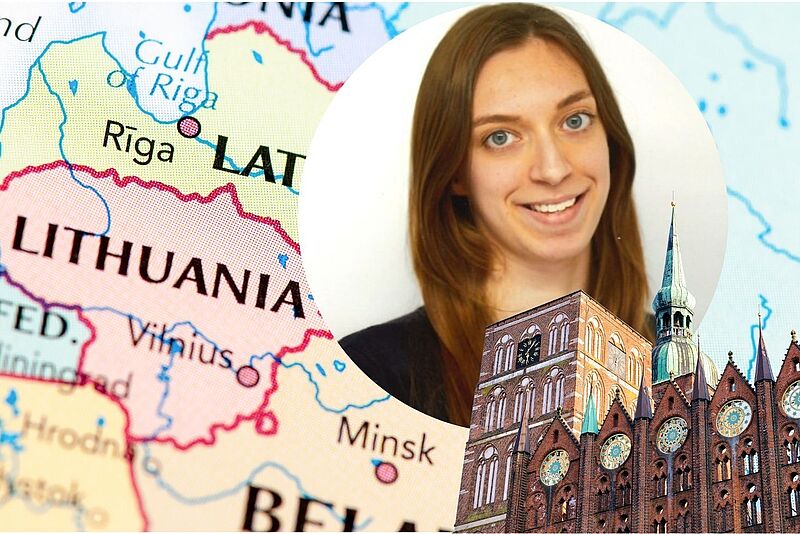
Two bachelor’s degrees – one course of study, no extra time spent at university. Almost too good to be true? – That is precisely the core idea behind the double-degree agreements in place at Stralsund University of Applied Sciences, as a recent example shows. Swantje Rebecca Hansen has become the first graduate of the International Management Studies in the Baltic Sea Region (BMS) programme to complete her double degree at the Lithuanian partner institution, Panevėžio Kolegija (PANKO), just two and a half years after the programme was launched.
“Two bachelor’s degrees without having to extend the duration of study. I think that’s a real advantage in an era of increasing internationalisation,” says Prof. Dr Marcus Scheibel, programme director of BMS, commenting on the study option. He had initially initiated the partnership between Stralsund University of Applied Sciences and PANKO and finalised it with his colleague Wencke Wendlandt, the coordinator of international relations at the Faculty of Economics. This means the BMS programme can now offer its students double degrees at three partner universities (in addition to the South-Eastern University of Applied Sciences (XAMK) and Kajaani University of Applied Sciences (KAMK) in Finland). For Swantje Rebecca Hansen, the concept has been a complete success.
Experiences from the double-degree programme
Studying at both universities was “quite different”, she says, “but above all very practice-oriented. I really enjoyed that,” she reports. For the programme, she even extended her required stay in Lithuania from six months to a year – “and I wouldn’t have missed that for the world”. “I was also able to put this international experience to good use in my subsequent work placement at an international logistics group. I’d already completed two work placements there. Alongside my international studies, this cemented my decision to work with international colleagues, and of course that works brilliantly at a logistics company,” Swantje Hansen explains. She also wrote her final thesis at the logistics group Dachser on the topic “The Impact of Internal Communication Strategies on Employee Engagement and Intranet Adoption. A Dachser Case Study’. She is now starting her trainee programme there, “to deepen my knowledge and specialise”. For the graduate of the international degree programme at HOST, this means another three-month stint abroad, for which she is well prepared.
What the professors say
“In our degree programme, we encourage our students, as part of the compulsory semester abroad, to get to know the countries and cultures of the Baltic Sea region,” explains Prof. Dr Marcus Scheibel. This should be made as straightforward as possible and have the greatest possible impact – which is why dual-degree agreements are highly valued for the programme.
The options at the university
The university offers seven international degree programmes, and it is primarily for these that the double-degree option is available. Four of these programmes are part of the Faculty of Economics.
The Faculty of Economics maintains active double-degree partnerships with six other higher education institutions:
- the state-funded Panevėžio Kolegija in Lithuania for the International Management Studies in the Baltic Sea Region (BMS) programme
- the South-Eastern University of Applied Sciences (XAMK) in Finland for the BMS programme
- Kajaani University of Applied Sciences (KAMK) in Finland for the BMS programme
- the University of the Sunshine Coast, Australia (USC), for the Leisure and Tourism Management (LTM) programme
- the Universitat Politècnica de València, Spain, for the LTM programme
- Montpellier Business School, France, for the LTM degree programme
It is standard practice for students to spend one year at the partner university and complete the remainder of their degree here. For the BMS programme, only one semester must be completed at the partner university.
Find out more about the Faculty of Business’s double degrees here
As part of EUNICoast, the European university alliance of which HOST is a member, the university is involved in the development of the following joint master’s programmes:
- Smart Marine Technologies
- Energy Automation Sustainable Engineering
- International Software Development
- Strategic Resilience Management for Island and Coastal Destinations
In addition, a double degree at Bachelor’s level in Electrical Engineering/Renewable Energies & E-Drives with the Universidad Pontificia Bolivariana (UPB), Medellín, Colombia, is currently in the preliminary stages of development.