| Degree programme | Software Development and Media Informatics – Bachelor’s (SMIB) |
| Faculty | Faculty of Electrical Engineering and Computer Science |
| Start of programme | Winter semester |
| Admission | No entry requirements |
| Duration of programme | 7 semesters |
| Credit points | 210 ECTS |
| Qualification | Bachelor of Science (B.Sc.) |
| Language of instruction | German |
- Secondary school leaving certificate (Abitur or equivalent) or
- College leaving certificate from a technical college (Fachhochschulreife or equivalent) or
- Master’s certificate under the apprenticeship system (Meisterabschluss) or equivalent professional vocational training examination or
- Entrance examination
Information for foreign applicants: Incoming
- Enrolment for this degree programme will no longer be accepted from the 2023 winter semester onwards!
- Please feel free to apply for the successor degree programme, Software Development and Artificial Intelligence
What do modern televisions and smartphones have in common?
Both systems are computers that are tailored to the needs of their users. Alongside the technical components, it is the software that determines what you can do with your television or smartphone. Two areas of computer science play a major role here: softwaredevelopment and mediainformatics.
Softwaredevelopment is about the programmes that enable us to solve problems using a computer. As well as the small programmes we know as apps, software also includes the operating system, application software – such as word processing and email programmes – and all the applications that provide us with services on the internet. For more complex programmes, teams work together on their creation in order to share the workload and incorporate specialist knowledge into the programme.
One of these specialist areas is mediainformatics. It deals with the processing of audio and video data using computers. One important aspect, for example, is the compression of media data for transmission to a television or smartphone. Without compression, existing networks would not be sufficient to transmit video data.
These two areas form the core focus of the Software Development and Media Informatics degree programme. In addition, there are core subjects in computer science and projects from other fields of application, such as robotics.
You can find some impressions here.
Aims and career prospects
Through the Bachelor’s degree programme in Software Development and Media Informatics (SMIB), we equip you to play a responsible role in the planning and development of software, the configuration and implementation of complex software systems within organisations, and the processing of multimedia data.
The Bachelor’s degree programme prepares you directly for a career in industry or serves as a foundation for a Master’s degree.
Job profiles
As a graduate of our Software Development and Media Informatics degree programme, you will have a wide range of career opportunities. This is because software is now required in almost every sector. Typical examples include: retail, banking, insurance, communications networks, smart device and building technology, mobile systems, multimedia systems, automation systems, biotechnology and environmental technology. Even cars and household appliances are now almost unimaginable without software. This opens up a wide variety of career paths for you. For example:
- Planning and developing client software as an employee of a software house
- Developing hardware and software systems for a device manufacturer or through your own engineering consultancy
- Advising on the selection and configuration of software systems as a consultant for a management consultancy
- Basic research in the field of information technology at large companies, universities or research institutions
- Planning, developing and administering hardware and software within a company
Right next door to the real world
Stralsund University of Applied Sciences is a young university with a comparatively young teaching staff and excellent technical facilities. In the field of computer science, the university can draw on more than 20 years of experience. Word has now spread amongst companies that Stralsund produces well-trained graduates. Many students already work for a company in the local area whilst they are still studying. Some of these companies have even opened a branch in Stralsund specifically to maintain close links with students and graduates.
The academic focus is ensured, amongst other things, by the Institute for Applied Computer Science (IACS) and the PhD students and professors working there.
Thanks to the broad-based foundation provided by the Software Development and Media Informatics (SMIB) degree programme, our graduates have every opportunity to fulfil their potential across a wide range of industries. Choosing a specialisation gives you the freedom to focus on your preferred areas of work even whilst you are still studying.
Our modern degree programme offers you plenty of variety with its two specialisations: Software Development and Media Informatics.
It comprises six consecutive academic semesters and one work placement semester. The programme concludes with the academic degree of Bachelor of Science (B.Sc.). You can then proceed to a Master’s programme either straight away or after gaining some work experience.
From the fourth semester onwards, you can choose one of the two specialisations: Software Development or Media Informatics. The tables show the programme structure for both specialisations:
During the first two semesters, we lay the foundations for your further studies. Alongside technical fundamentals and mathematics, you can expect to learn the basics of programming and receive an introduction to computer science. In addition, you will develop key practical skills such as English and communication. In almost all subject areas, practical work in the laboratory is used to complement the lectures, enabling you to gain immediate hands-on experience of the subject matter. You will also be introduced to the department’s current research projects, giving you an initial insight into the work of project teams.
Before the work placement semester – which is usually undertaken outside the university – your computer science knowledge is consolidated in the third and fourth semesters. In addition to further fundamentals of computer science, such as algorithms and data structures, Databases I and network security, the curriculum includes topics from software development (Software Engineering I, Web Engineering I) and media informatics (Graphical Data Processing, Media Informatics I).
The work placement semester is designed to give you an insight into everyday working life and also to help you establish contacts with companies. Here you can apply what you have learnt in a practical setting.
The modules in the 6th and 7th semesters are designed to further deepen your knowledge and allow you to specialise (blue – Software Development, orange – Media Informatics). These modules become increasingly project-oriented, guiding you towards independent learning and working.
For the Software Development specialisation, one example is the organisation of larger software projects. Software project organisation is carried out in teams based on a current project that changes each semester. In the Media Informatics specialisation, one example is the Audio/Video laboratory practical. In this course, a short film on a current topic is shot in order to run through the entire process of a media production.
All these modules serve as preparation for the Bachelor’s thesis, which takes up half of the 7th semester. Interesting topics are available for this, drawn from both companies and projects at the university.
What type of student are you?
As well as the option to study the Bachelor’s degree programme in Software Development and Media Informatics on a full-time basis, the programme can alternatively be undertaken as a programme with an in-depth practical component or on a part-time basis. This allows students to tailor their studies flexibly to their personal needs, whether these relate to family or work.
Insights into the degree programme
Curious? Then let our Software Development and Media Informatics degree programme inspire you a little further.
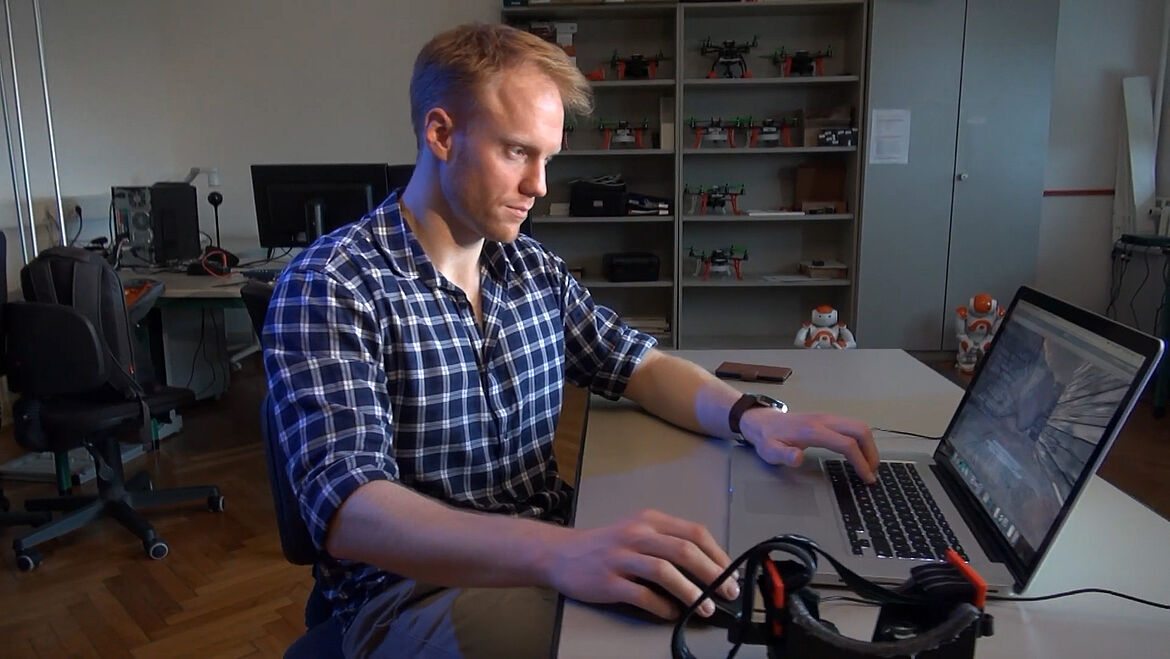
Please note: Once you watch the video, data will be transmitted to Youtube/Google. For more information, see Google Privacy.
BerufeTV video: Software Engineering
As part of the Employment Agency’s ‘BerufeTV’ programme, our Software Development and Media Informatics degree programme was selected as an example of the field of software engineering and featured in a video: BerufeTV