
The Robotics Laboratory has several robot cells and workstations, which are used for both teaching and research.
The courses provide students with knowledge of the design, operation and programming of industrial robots and mobile systems. Using the available robot systems, students can gain practical experience in handling and programming robots and their peripherals. The course also covers PLC programming and the integration of basic safety concepts.
In the field of research, professors, staff and students are currently working on human-robot interaction and the integration of artificial intelligence into process and sequence control.
The following hardware systems and digital simulation environments are available for the development, programming and investigation of a wide variety of automation strategies:
To get started in robotics and to work collaboratively in the laboratory, modern, open teaching systems are available, providing a safe environment for students to gain their first programming experience in small groups.
Niryo NED2 (training system)
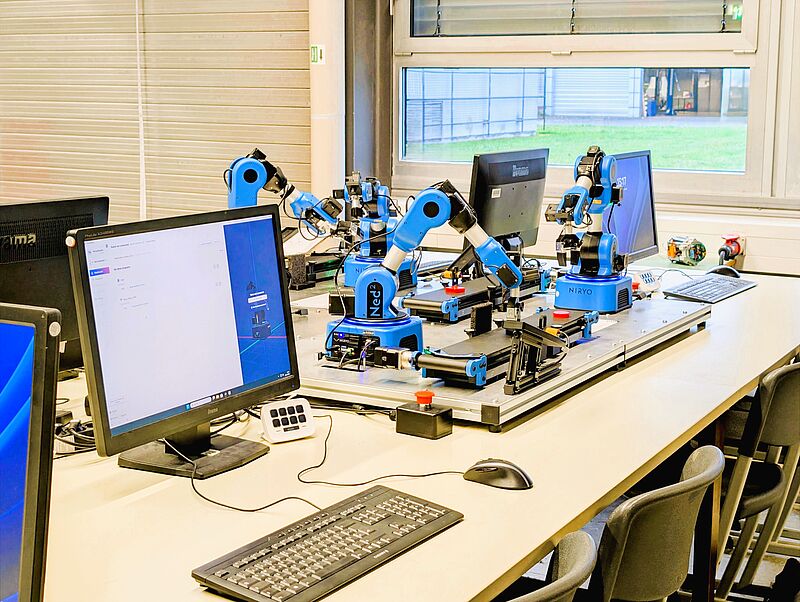
- 5 fully equipped workstations for parallel work
- Niryo NED2 6-axis robotic arm
- rated payload: 0.3 kg
- reach: approx. 0.5 m
- repeatability: ±0.5 mm
- manual, magnetic end-effector changeover system
- integrated, ROS2-based control system
- integrated camera system with OpenCV interface
- conveyor belt, 0.6 m long
- Python-based programming interface
This area covers traditional industrial robots, such as those used in production and manufacturing worldwide. The systems are used to provide practical training in control engineering, system integration and handling.
Industrial robot cell

- two KUKA KR16 robots with KRC2 control systems
- 6-axis robotic arms
- rated payload: 16 kg
- reach: 1.61 m
- pneumatic end-effector changeover system
- pneumatic parallel gripper
- SICK safety PLC for system monitoring
- additional workspace monitoring with SICK laser scanners and PLC
- Beckhoff software PLC for process control
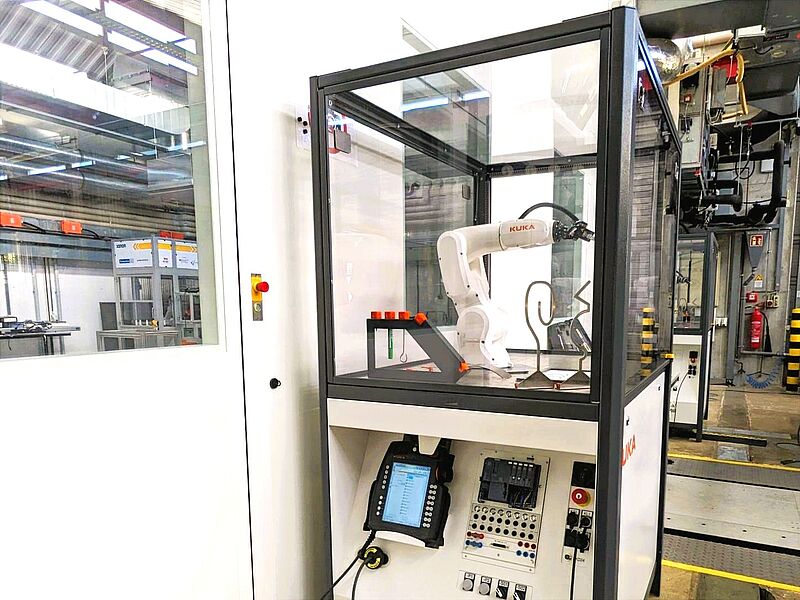
KUKA R2E Vision
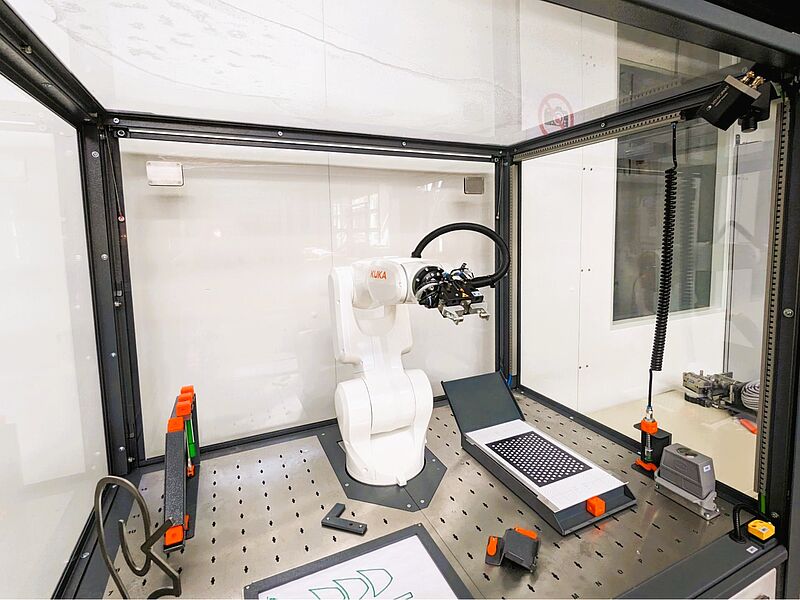
- KUKA KR4 Agilus 6-axis robotic arm
- rated payload: 4.0 kg
- reach: 0.6 m
- repeatability: 0.02 mm
- pneumatic parallel gripper and vacuum gripping system
- KRC5 micro controller with interfaces for image processing
- equipped for manual and path-guided applications
- camera system for vision-assisted processes
Collaborative robots are designed to enable direct interaction between humans and machines without the need for protective barriers, and are equipped with specialised sensors.
In order to plan layouts efficiently and test complex movement sequences safely before they are put into practice, state-of-the-art software solutions for 3D simulation and offline programming are used in the laboratory.
KUKA.Sim
- 3D simulation software for the virtual layout planning and programming of industrial robot cells
- offline programming (OLP) of the KUKA systems (KR16, R2E) available in the laboratory, directly on the PC
- carrying out reachability checks, cycle time analyses and preliminary collision detection checks in the virtual factory environment
- seamless transfer of the programmes created and simulated offline to the actual KUKA robot controller
ROS2 (with Gazebo and MoveIt)
- open-source framework for simulating complex processes, sensor data and motion sequences
- use of MoveIt for path planning and inverse kinematics, and Gazebo for realistic 3D physical simulation
- use of digital models for open-architecture teaching systems (Niryo NED2) and collaborative robots (Jaka 14 pro)
- offers a flexible development environment, particularly for student projects and research work in the field of autonomous robotics